
The Bible: Where to Start Reading
Inspired by the Holy Spirit, the Bible is the most important book ever created.
It offers history lessons, instructions for life and a promise for eternity.

The Bible was inspired by God's Holy Spirit.
Who Wrote the Bible?
Before anyone starts reading the Bible they should understand who the author is. The best way to answer questions about where the Bible came from, and how we are assured that the Scriptures are divinely inspired is to use actual verses from the Bible.
"For no prophecy was ever produced by the will of man,
but men spoke from God as they were carried along by the Holy Spirit."
- 2 Peter 1:21 (ESV)
"All Scripture is breathed out by God and profitable for teaching,
for reproof, for correction, and for training in righteousness,"
- 2 Timothy 3:16 (ESV)
"Now we have received not the spirit of the world, but the Spirit who is from God,
that we might understand the things freely given us by God.
And we impart this in words not taught by human wisdom but taught by the Spirit, interpreting spiritual truths to those who are spiritual."
- 1 Corinthians 2:12-13 (ESV)
The Bible has Two Primary Parts
The first two-thirds of the Bible is called the Old Testament, which was written in the ancient Jewish language of Hebrew between 1,400 BC and 400 BC. Credited to Moses, the Old Testament begins with the story of creation in the book of Genesis and transitions to God’s covenant with Abraham (land & nation). The Old Testament continues with story of Moses and God’s laws found in the 10 Commandments, Israel’s leaders, the nation’s struggles with its faith in God and the many prophets who provided warnings and prophecies that are still being fulfilled today.
The second part is called the New Testament. Written primarily between the years 50 and 100 A.D., the New Testament reviews and evaluates the ministry of Jesus Christ, the establishment of the New Covenant for all who believe in Him and the events of 1st-century Christianity.
The first four books of the New Testament are called the Gospels. These books offer an intrinsic examination of Christ's inspiring journey from birth to His resurrection, offering countless quotes, parables and the amazing miracles and sacrifices that He made during his three-year ministry between 30 and 33 A.D. The term "gospel" originates from the Old English word godspel, meaning "good news," which translates the Greek word euangelion, literally "good tidings" or "glad news" about Jesus Christ.
Next comes The Book of Acts which serves as a history lesson after Christ's ascension to heaven. Topics include the day of Pentecost and the spread of the Gospel from Jerusalem to Rome as well as the missionary work of Peter and Paul.
The majority of the rest of the New Testament includes the Apostle Paul’s letters (called epistles) of which most were written to the early churches of the Greek speaking cities in Asia Miner (present day Turkey). Paul's letters offer concise relevant information for readers in today's modern era. These letters discuss God's judgement and salvation, instructions on love, holiness, handling disputes, faith in action and suffering for our righteousness.
The New Testament ends with John’s book of Revelation which provides a prophetic and symbolic vision of end of time events leading up to the inevitable second coming of Christ, His victory over evil and the promising eternal future of mankind.

Choosing the Best Translation
The first decision one should make is to choose the appropriate translation that they find the most inspiring and easiest to comprehend. Different translations can serve different purposes.
20th century translations like NIV, NLV and ESV are best utilized for in-depth study, teaching, and preaching due to its "essentially literal" translation of Bible philosophy. It strikes a balance between accuracy to the original Old Testament Hebrew, and New Testament Greek languages for an English-speaking audience.
Older translations like the 17th-century King James (KJV) version can provide poetic memorability and historical significance, making it a good option for devotional reading, formal public reading, and memory work. It is widely used by those who appreciate the cadence and majesty of its 17th-century English phrasing.
King James Version (KJV) - Commissioned in 1604 by King James I of England, it was produced by a team of scholars and became the standard English Bible for Protestant churches for centuries. Published in 1611 A.D. and revised in 1629, 1638, 1762, and 1769 to correct errors and update language, it is still popular today. While this version was the most popular historically speaking with the use of Early Modern English (the same literary style used by Shakespeare) making it a rather nostalgic translation. It is characterized by Elizabethan-era vocabulary and grammar, using now-archaic pronouns (thou/thee).
New International Version (NIV) - Initiated in 1965 to create a modern English translation, the project released the New Testament in 1973, followed by the full Bible in 1978. Major revisions were later released in 1984 and 2011. The NIV Bible is characterized by its "balanced approach" to translation, commonly described as a "thought-for-thought" (dynamic equivalence) rather than word-for-word, to maximize both accuracy and modern readability. It was created by a diverse team of over 100 scholars, making it a committee-based, modern translation rather than a revision of older versions. The NIV is the most widely read contemporary English Bible translation, with over 650 million copies distributed worldwide.
New Living Translation (NLT) - The NLT is a meaning-based translation that was created by over 90 scholars and published in 1996 with additional revisions in 2007 and 2015. The NLT focuses on expressing the original meaning in a more natural, contemporary English over literal word-for-word accuracy. Its goal is to make the Bible easier to read, yet highly coherent when audibly spoken by pastors and teachers. It is often described as flowing like a novel, making it highly useful for new believers, youth, or devotional reading.
English Standard Version (ESV) - The ESV translation is the most recent of the four listed here, as it was published in 2016. A team of scholars started working on the translation in the mid 1990s, but the inspiration goes all the way back to Erasmus in the year 1516 when he created the Greek New Testament, which became the basis for the Tyndale New Testament, which then became the basis for the King James Version Bible. Due to its rhythmic and formal tone, the ESV is well-suited for memorizing scripture. Its clarity and precision make it a good, reliable choice for pastors and for small group studies. The translation is considered to be reliable for showing how important terms like "grace," "faith," and "justification" are used across different books in the Bible.

Authors of the Four Gospels: Matthew, Mark, Luke, and John
Where to Start for a New Reader
Anytime one reads the Bible it is best to relax, meditate and pray for clarity and discernment before you start reading. Focus on a few verses and/or a chapter and reflect on its meaning and how it could relate to your own life, those around you, or greater society.
Because the New Testament focuses on the life, teachings and salvation of Jesus Christ, which is the foundation of Christianity, it is commonly considered to be the first part of the Bible to begin reading. Compared to the Old Testament, the New Testament message and communication style is also more relevant and better suited for individuals living in today's modern society as it covers modern issues like practical life lessons, ethics, morality, relationships, love for others, sacrifice, grace and forgiveness. The New Testament brings greater clarity and explains the fulfillment of the promises made in the Old Testament, acting as the final act of the story of redemption.
The Four Gospels
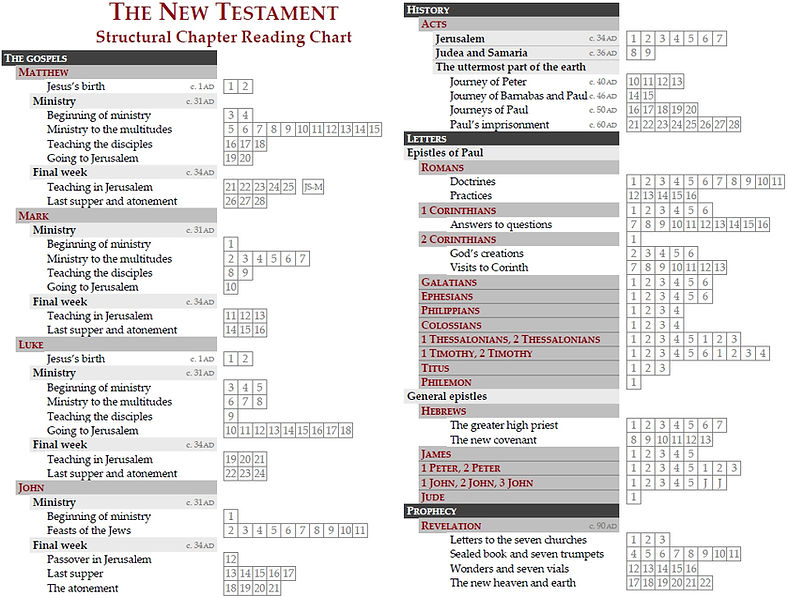
Located at the beginning of the New Testament the Four Gospels tell us about the life, ministry, death and resurrection of Jesus Christ. The first three are called the Synoptic Gospels because they are similar. See the adjacent image.
When reading the Bible for the first time, it is best to start with one or all four of these books first. One might ask why are there four books? Because they all provide a different perspective.
Matthew: Connects the Old Testament to Jesus, revealing His authority, fulfilling prophesy.
Mark: The earliest and shortest Gospel, concise, highlighting Christ's ministry and miracles.
Luke: Offers a Greek perspective, chronological review of Christ's ministry, parables, compassion.
John: Most unique, emphasizes Christ's love, symbolic divinity, miracles during 3-year ministry.

After the Gospels, Where Next?
After reading at least one of the Four Gospels, there are three really good options.
1) Continue with Paul's letters like Romans, 1st & 2nd Corinthians, Galatians & Ephesians.
2) Get a history lesson in Acts on how the message of Christ proliferated from Jerusalem to Rome.
3) Or go to the beginning of the Old Testament to read the creation story in Genesis, then moving to King David's books of Psalms and Proverbs for daily devotional reading, wisdom and poetry.
Paul's letters are excellent Scriptures that provide a powerful message that translates very well to the many issues we face today in our modern society. Paul sent these letters to various churches and gentile Greek communities to offer encouragement with the opportunities and problems they were enduring. As new believers, Paul effectively brings the life and resurrection of Jesus into an actionable theology that is practical for daily life while addressing timeless issues like faith, family and culture that are relevant today.
Romans: Explains how all people sin and fall short of God's glory, and that mankind is redeemed through the sacrifice and resurrection of Jesus Christ. It explains the core message of salvation by grace through faith rather than works, offering assurances of God's love, providing hope and peace in how we should interact with secular society, urging readers not to conform to worldly standards.
1st Corinthians: 1st Corinthians addresses real life issues like division in the church, dealing with immorality and holding up to a standard of purity, righteousness and redemption as a gift from God.
2nd Corinthians: Paul discusses strength though weakness and how God works through personal strife and suffering to bring a reliance on faith to repair broken relationships, thus fostering unity.
Galatians: Details how Christians are free from restrictive Jewish laws, emphasizing how we are not saved by rule-keeping, but by grace, growing in the Holy Spirit, resulting in character change.
Ephesians: The book begins with church doctrine and moves to practical concepts with marriage, work and personal conduct. It details steadfastness against evil though truth and righteousness.
Traditions and laws in the Jewish community prior to the era of Jesus were often carried from one generation to the next audibly through oral sayings and proverbs. As time passed after Christ's ministry ended in 33 A.D., the people who witnessed His teachings and miracles were gradually passing away. So, by 50 A.D. the need to transfer oral records into written text was vital in securing the most accurate record of Christ's ministry. This is why the New Testament is an authentic set of books because it was organized by people who had either witnessed Christ's ministry firsthand or had access to those who did.
The Apostle John was the youngest of the 12 disciple and probably around 18 when he met Jesus. Interestingly, he ended up being the only one that was not martyred for his faith. John lived to be an old man, authoring the apocalyptic book of Revelation while in exile on the Greek island of Patmos around 95 A.D. This outcome may have been the result of Jesus who, while hanging on the cross, had requested that John, the beloved, look after His mother Mary after He was gone.
"When Jesus saw his mother standing there beside the disciple he loved,
he said to her, “Dear woman, here is your son.”
And he said to this disciple, “Here is your mother.”
And from then on this disciple took her into his home."
- John 19:26-27 (NLT)
Learn more about the disciples, their life stories and other important individuals from the Bible on the Apostles webpage.

© 2026 Faith and Physics Inc. - All Rights Reserved
Bible Lessons
Reading the Bible, Where Do I Start?
Main Links
tm.jpg)